

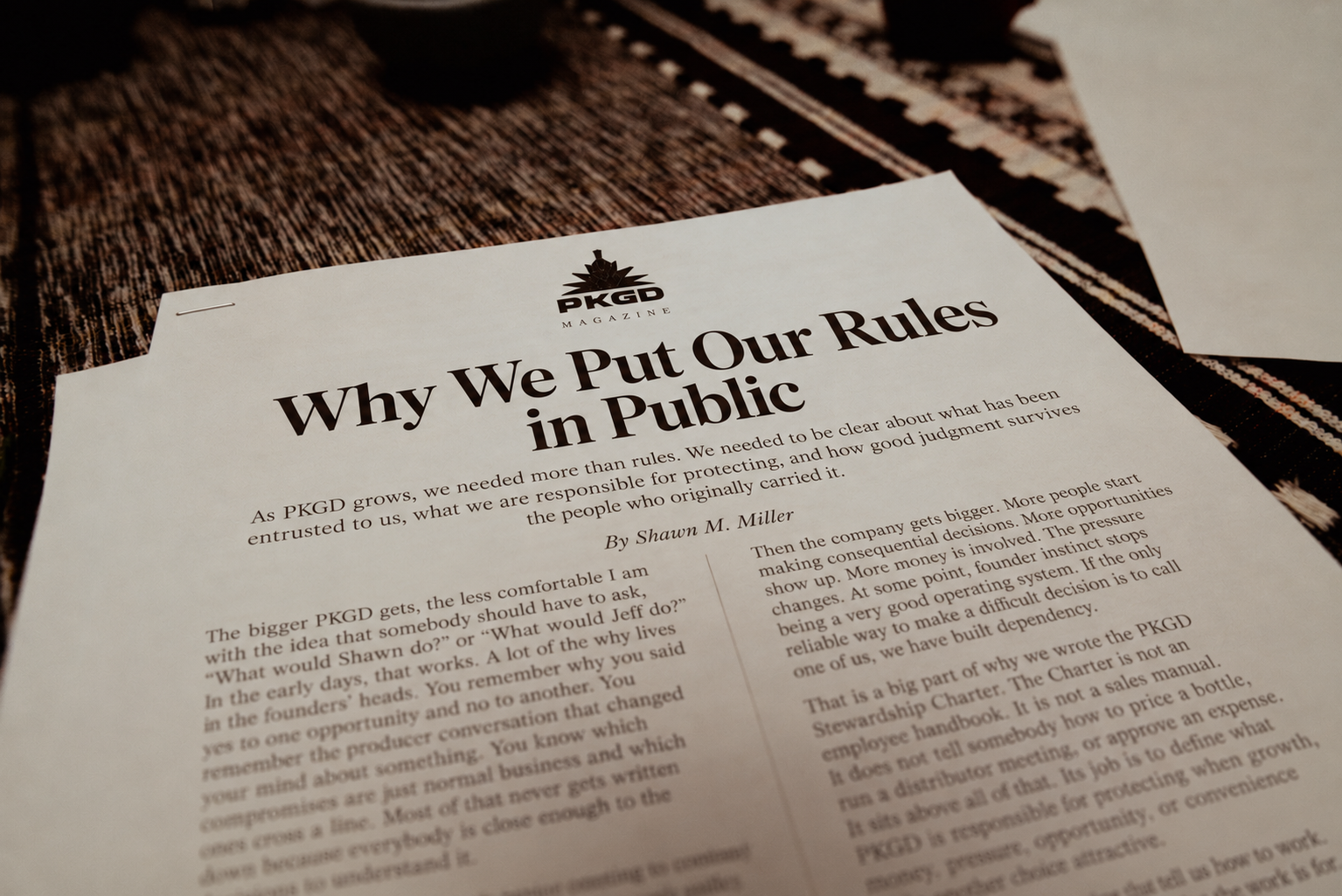
The bigger PKGD gets, the less comfortable I am with the idea that somebody should have to ask, "What would Shawn do?" or "What would Jeff do?" In the early days, that works. A lot of the why lives in the founders' heads. You remember why you said yes to one opportunity and no to another. You remember the producer conversation that changed your mind about something. You know which compromises are just normal business and which ones cross a line. Most of that never gets written down because everybody is close enough to the decisions to understand it.
Then the company gets bigger. More people start making consequential decisions. More opportunities show up. More money is involved. The pressure changes. At some point, founder instinct stops being a very good operating system. If the only reliable way to make a difficult decision is to call one of us, we have built dependency.
That is a big part of why we wrote the PKGD Stewardship Charter. The Charter is not an employee handbook. It is not a sales manual. It does not tell somebody how to price a bottle, run a distributor meeting, or approve an expense. It sits above all of that. Its job is to define what PKGD is responsible for protecting when growth, money, pressure, opportunity, or convenience make another choice attractive.
We have plenty of systems that tell us how to work. The Charter is there to remind us what the work is for.
The word at the center of the Charter is stewardship. That was intentional.
In reality, almost nothing we are responsible for protecting originated with us. Maybe literally nothing. We did not create these producer families, their history, their knowledge, their production methods, or the places these products come from. We did not create the trust producers placed in us, the relationships that give us access to markets, or the cultural context that gives these brands meaning. Even much of the opportunity we have today exists because somebody else built something worth carrying before we arrived.
We were given access to those things. And access creates responsibility.
That is what stewardship means to me. It does not mean preserving everything exactly as we found it. It does not mean avoiding growth, making timid decisions, or pretending commercial reality does not matter. It means recognizing that when something important has been entrusted to you, your ability to benefit from it comes with a responsibility to protect it, strengthen it, and, wherever possible, leave it stronger than you received it.
That mindset changes the question. Instead of only asking, "What can we do with this opportunity?" we also have to ask, "What are we responsible for while we are doing it?" That is the reason the Charter exists.
When we worked through the Charter, we eventually got down to three commitments:
Those aren't marketing lines. They are rules for us.
Producer ownership means more to us than whose name is on the cap table. The people closest to the product, the process, the place, and the consequences need to retain meaningful authority over what the brand is and what it becomes. The governing question is not simply who owns the brand. It is who still has the authority to protect what the brand is, how it is made, why it exists, and what it must not become.
World-class quality means growth cannot become an excuse to make the product easier, cheaper, or more convenient if doing so compromises the reason it deserved to grow in the first place. Transparency means our communication should bring people closer to the truth, not create a more convenient mythology.
We summarize a lot of this internally with:
Built Right. Brought Right.
Producer-Owned. World-Class. Transparent.
The words are simple. The decisions underneath them usually are not. An obviously bad opportunity is easy to decline. The harder decisions are attractive:
Those are the moments when having a standard matters. The Charter gives us some pretty simple questions for those moments:
Those questions do not magically make a difficult decision easy. They do make it harder to make one carelessly.
We could have kept the Charter internal. That would have been easier. But the more I thought about it, the less sense that made. If we are going to ask producers, employees, distributors, retailers, and other partners to trust our judgment, I think they should be able to see the standard we say we are using. And if we depart from it, they should be able to point at the same document we can.
Putting it online does not prove we are going to live up to it. It does mean nobody has to take our word for what we say we believe. That is part of accountability. It also does not mean every agreement, negotiation, or internal decision suddenly becomes public. Transparency does not require us to publish confidential business information. It means the principles behind the decisions should not be hidden.
That is why we built the Governance section on PKGDGroup.com and put the Stewardship Charter there. Not because publishing it makes us more virtuous. Because it makes the commitment visible. And I think there is value in making it possible for somebody outside the company to say, "You told us this was the standard. Does this decision still meet it?"
We should be willing to answer that question.
There is another reason for the Charter that may matter even more over time. I don't want people at PKGD memorizing my preferences. I want them to understand what we are responsible for protecting. Those are very different things. The goal is not more rules. The goal is that good judgment does not disappear when Shawn or Jeff leaves the room.
That requires more than writing a document. It means leadership has to turn experience into language, standards, systems, training, and correction so other capable people can understand the responsibility and exercise judgment themselves. That is the part of governance that interests me most.
Not a rulebook. A way to make good judgment easier to carry.
Publishing the Charter does not mean we are going to get every decision right. We won't. We will grow. We will get pressured. Opportunities will show up that look very attractive. People will disagree. We will make mistakes. The value of the Charter is that when that happens, we have somewhere to go back to. It also makes it a lot harder to quietly rewrite what we believe after the fact because the easier choice suddenly looks convenient.
That is probably the part I like most about putting it in public. We are not trying to build a company that never changes. We are trying to build one that can change without forgetting what it was responsible for protecting.
That is stewardship as I understand it. We have been given access to brands, producers, relationships, trust, and opportunity that we did not create alone. The question is not simply what we can build with them. The question is what we protect, what we strengthen, and what we eventually return.
That is why we wrote the PKGD Stewardship Charter. And that is why we put our rules in public.
You can read PKGD's Governance principles and the full Stewardship Charter here:
Built Right. Brought Right.
Producer-Owned. World-Class. Transparent.
This article was structured with the assistance of artificial intelligence (ChatGPT). All content is based on human input and editorial oversight. For more details on how PKGD integrates AI responsibly, please refer to our AI Policy.
This article was structured with the assistance of artificial intelligence (ChatGPT). All content is based on human input and editorial oversight. For more details on how PKGD integrates AI responsibly, please refer to our AI Policy.
At PKGD, we continue investing in brand-led storytelling, creating work designed not only to perform, but to build long-term brand equity.
By accessing and using PKGD´s website, you agree to the cookie policy outlined in our privacy notice.
By accessing and using PKGD´s website, you agree to the cookie policy outlined in our privacy notice.













Leave a reply
Lorem ipsum dolor sit amet, consectetur adipiscing elit. Suspendisse varius enim in eros elementum tristique. Duis cursus, mi quis viverra.
Lorem ipsum dolor sit amet, consectetur adipiscing elit. Suspendisse varius enim in eros elementum tristique. Duis cursus, mi quis viverra.