



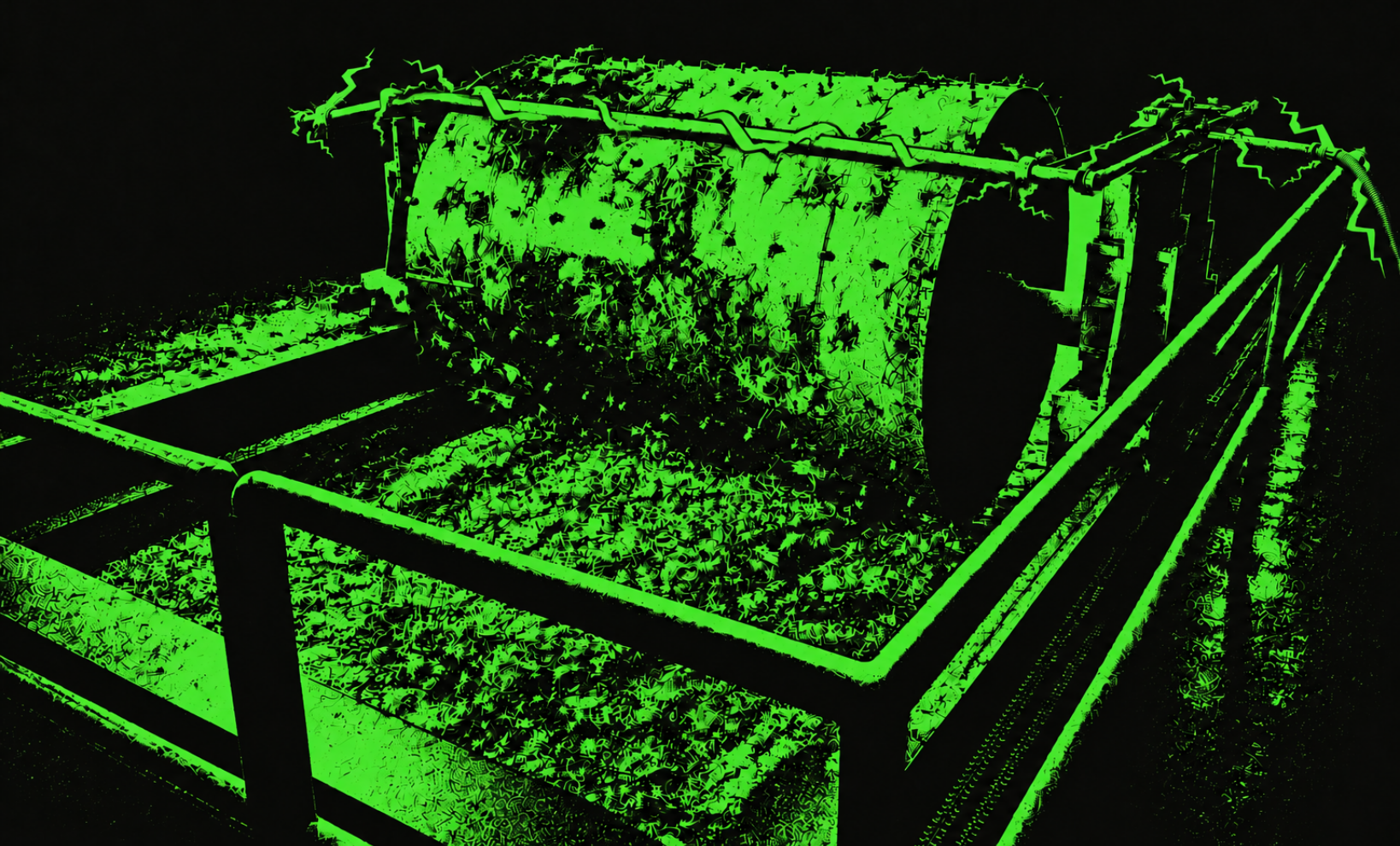
At first glance, it looks like the kind of machine you would expect to find in a badly told story.
It is enormous, heavy, and strange. Built from parts rescued from entirely different worlds, a roller from an old road compactor, an axle from a railway car, bearings recovered from a trailer scrapyard, it moves on rails, traveling back and forth over cooked agave. And it carries a name that does not try to hide its own oddness: Felipestein.
The nickname fits. The machine looks assembled like an improbable creature.
But that comparison ends there.
Felipestein does not exist to create a monster. It exists to solve a problem.
In the simplest tequila imaginary, machinery tends to trigger suspicion. The handmade is associated with truth. The mechanical, with intervention. The traditional, with purity. The designed, again, with intervention.
That reading may feel intuitive, but it does not always help us see clearly.
Sometimes a machine does push a process toward standardization. Sometimes it corrects so much that the product no longer reveals origin, but design. But not every technical intervention works that way. There is another possibility too: that engineering does not erase the product, but helps it express more precisely what it already is.
That is where Felipestein enters.
At El Pandillo, Felipe Camarena’s distillery in the highlands of Jalisco, this machine serves as a mechanical tahona. Its job is to crush cooked agave and extract its sugars. Rather than literally copying the traditional stone tahona once pulled by a mule, Felipe started from the logic that made that method valuable, gentleness, work over the fiber, careful extraction, and rebuilt it on his own terms.
Felipestein does not come from the impulse to modernize for the sake of modernizing. It comes from a more demanding question:
how do you preserve what matters in the method while also making it work better?
The answer was a system that is strange, heavy, and deeply personal. Instead of the circular rotation of a traditional tahona, Felipe imagined a linear back-and-forth motion. The machine moves across cooked agave fiber to wash and extract sugars more efficiently.
Before that step, another machine designed by him, Igor, tears apart the cooked piñas without clogging, leaving the fiber ready for final extraction.
Together, the two machines say something important about the working logic at El Pandillo. This is not about adopting technology as a symbol of progress. It is about building specific tools for specific problems in agave.
It also helps us read Felipe Camarena more clearly. For years, he has carried the nickname of the “mad scientist,” an almost inevitable label for someone who designs his own machinery, redraws production flows, and turns a distillery into a system of applied observation.
But that image only touches the surface.
What appears at El Pandillo is not eccentricity.
It is judgment.
Before dedicating himself fully to tequila, Felipe spent decades in civil engineering and construction. That background does not appear in G4 as a pose of innovation, but as a discipline of problem-solving. The natural slope of the distillery became a gravity-fed system for moving materials and liquids with less pumping. The thermal and cooling system was designed to reduce water use. Fermentation tanks were adapted so that fiber could remain where it adds flavor and be removed where it gets in the way of the next step. The ovens were redesigned to cook agave more evenly.
In each case, the logic is the same: observe a real limitation in the process and adjust the system without stepping away from responsibility for the result.
In that sense, Felipestein is less an isolated oddity than a visible part of a broader philosophy.
And beyond that, it works.
The machine achieves extraction close to 97% of the sugars in the agave fiber. Where a traditional tahona might process around 3 tons of agave in an eight-hour shift, Felipestein can handle 10 to 12 tons in that same time. And it does so, according to the available information, after more than a decade of reliable operation, even under double shifts as the distillery has grown to meet global demand.
These figures do not matter because they make the machine impressive. They matter because they help answer the right question:
what is technique doing here?
Not manufacturing prestige.
Not making the product interchangeable.
Not imposing an aesthetic of innovation.
It intervenes to refine a way of making tequila.
That point is worth underlining because, in contemporary agave discourse, technique is often misread. Sometimes it is celebrated as if any mechanical complexity were an automatic sign of excellence. Other times it is condemned as if any technical mediation were a betrayal of the product.
Neither of those readings is enough.
Technique, on its own, guarantees nothing. What matters is the relationship between tool, judgment, and result.
In G4, that relationship does not appear as a collection of gadgets or as a narrative of futurism. It appears as a chain of decisions whose meaning is only fully understood in the glass.
The tequila has to answer first. Then the story explains why it can.
That is why Felipestein is such a useful image. It looks like a mechanical creature pulled from an improbable workshop, but it actually embodies a more difficult and more interesting idea: a living method is not protected by freezing it in place. It is protected by adjusting it responsibly.
That may be one of the most valuable lessons in G4.
Not every machine erases character.
Not every intervention creates uniformity.
Not every fidelity to origin consists of repeating intact what already existed.
Sometimes, preserving an identity requires building a new tool.
Sometimes, the most serious way to respect a process is to intervene in it with enough judgment that it can keep telling the truth.
Felipestein may look like a monster.
But at its core, it suggests another reading: not that of a creature set against nature, but of a machine placed in service of something much harder to preserve.
A tequila’s ability to remain recognizable while the agave, the environment, and the conditions around it continue to change.
This article was structured with the assistance of artificial intelligence (ChatGPT). All content is based on human input and editorial oversight. For more details on how PKGD integrates AI responsibly, please refer to our AI Policy.
At PKGD, we continue investing in brand-led storytelling, creating work designed not only to perform, but to build long-term brand equity.
This article was structured with the assistance of artificial intelligence (ChatGPT). All content is based on human input and editorial oversight. For more details on how PKGD integrates AI responsibly, please refer to our AI Policy.


Fermentation is not just a production stage. It is one of the clearest ways to understand how a spirit becomes itself.
A heavy bottle can make a spirit seem important before the liquid has shown why it matters.

Some tequilas seem built to produce a favorable reading before they truly show how they were made.
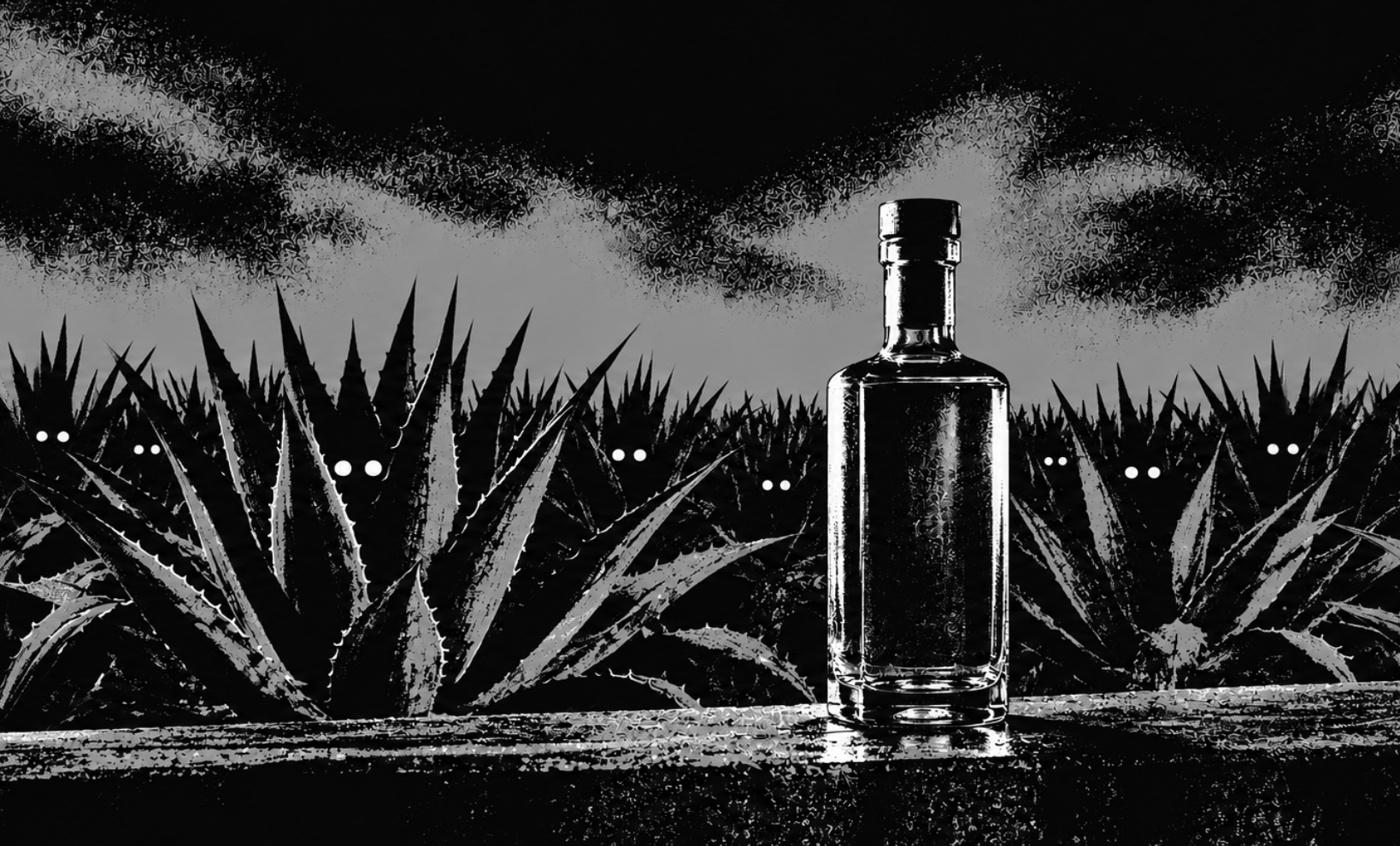
Raicilla is often explained by comparison before it is understood through identity.

Celebrity tequila does not erase the producer. It teaches the consumer not to look for them.
Four producers reveal what cannot be sacrificed if a spirit is to remain fully itself.

By accessing and using PKGD´s website, you agree to the cookie policy outlined in our privacy notice.
By accessing and using PKGD´s website, you agree to the cookie policy outlined in our privacy notice.

































Leave a reply
Lorem ipsum dolor sit amet, consectetur adipiscing elit. Suspendisse varius enim in eros elementum tristique. Duis cursus, mi quis viverra.
Lorem ipsum dolor sit amet, consectetur adipiscing elit. Suspendisse varius enim in eros elementum tristique. Duis cursus, mi quis viverra.