



Every September, Mexico becomes impossible to miss in the American spirits business.
Green, white, and red fill storefronts and restaurant menus. Bottles become symbols of el Mes Patrio. We raise glasses to Mexico, and buying something Mexican can feel like supporting Mexico itself.
But is buying the symbol the same as supporting what it represents?
I am a gringo who has spent more than a decade working with Mexican agave spirits. I have been welcomed into distilleries, ranches, homes, and conversations I had no right to expect. That proximity has taught me a great deal, but it has not made Mexican culture mine to define.
It has made me more responsible for how I participate in it.
I also make my living helping Mexican spirits reach the United States. I am not examining commerce from a safe distance. I am part of the system I am asking us to question.
“100% Agave” matters. In tequila, it means the fermentable sugars come entirely from Blue Weber agave and the tequila is bottled at origin.
That is real information about what is in the bottle. It is not the whole story behind it.
The words do not tell us who grew the agave, who made the tequila, who owns the brand, who decides what changes when commercial pressure arrives, or who participates in the long-term value if the brand succeeds.
Authenticity cannot live entirely on the front label.
The question is not whether a Mexican spirit becomes an industrial product. It is whether the commercial system stays connected and accountable to the people who gave that product its meaning.
Contract production can create meaningful revenue, jobs, capacity, and stability for a Mexican producer. A producer may sincerely promote a brand made at their distillery because its success matters to the business. Those benefits and that enthusiasm can be completely real.
But production income and brand ownership are not the same thing.
When the people who make a spirit also own its brand, repeated demand can build more than production revenue. It can build an asset they own: the name, customer demand, pricing power, enterprise value, and something that may be carried into another generation.
When ownership is joined by protected authority over the liquid, the people closest to the consequences can also decide what changes, and what does not, as demand grows.
Producer-owned does not guarantee better flavor, fair labor, sustainability, or good behavior. Each of those deserves its own evidence. Ownership answers a narrower but consequential question:
Whose brand are we helping build?
Producer ownership explains why the choice can matter. Taste, value, and occasion determine whether the choice deserves to be repeated.
No consumer should need to become a corporate investigator to buy a bottle. Brands and the trade should make these answers easier to find. Until they do, one question gets us surprisingly far:
Is this the maker’s own brand, or a brand they make for someone else?
A NOM can identify the authorized tequila producer. It does not, by itself, prove who owns the brand. Look for a clear answer on the bottle or brand website. Ask the bartender, retailer, or supplier. If the answer remains unclear, call the relationship unknown, not automatically bad.
Then act according to your role. The principle matters only when the product also earns a useful place.
If you are a consumer: Start with the occasion. Is it a house pour, dinner bottle, cocktail, gift, or celebration bottle? Let taste, value, and usefulness earn the first purchase. When it fits and delivers, buy it again. Order it by brand and producer name. Ask your store or bar to keep it. Recommend it accurately. One trial creates a transaction. Repeat demand helps build the brand asset.
If you are a bartender: Place verified maker-owned spirits where they solve real menu needs: a house pour, a premium cocktail, or a neat recommendation. Train staff on three separate facts: maker, owner, and final decision-maker. Give guests the useful version: “This is made and owned by the same family. Your repeat order helps them build their own brand.” Then measure whether guests reorder it.
If you are a retailer: Make verified ownership visible after you merchandise the bottle by real consumer need and price. Give staff one sentence. Test a maker-owned shelf set, tasting, or feature, then compare velocity and reorders. The point is not charity. It is helping customers act on a preference while letting the product prove its commercial value.
Lou Bank and I once discussed the precious tension between mezcal as cultural heritage and mezcal as business. Both can be true. Commerce can carry culture farther, pay wages, create opportunity, and help a new generation continue the work. The danger is not that culture creates economic value. It is that the value becomes separated from the people who created the culture.
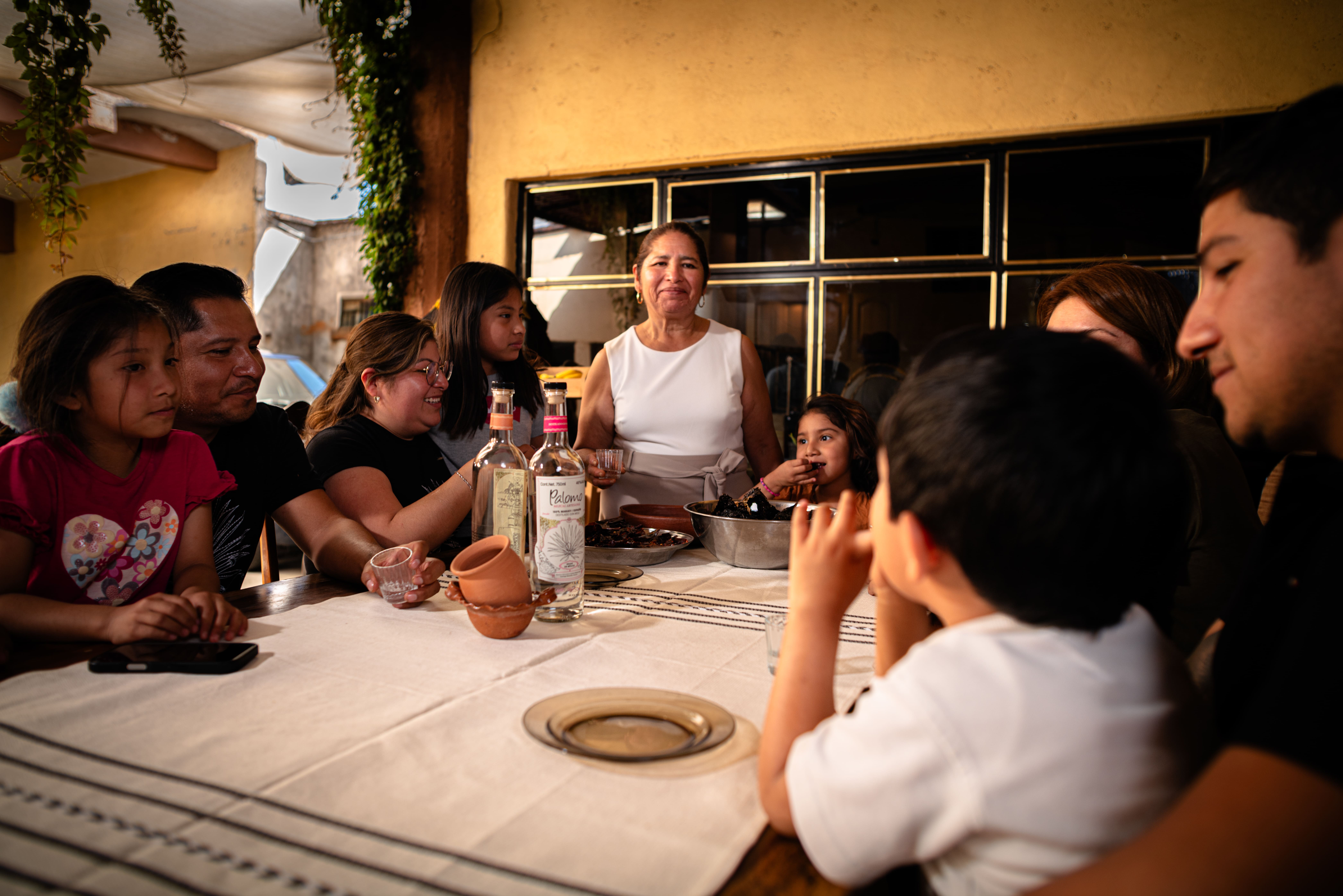
On the way to Rancho Pelayo, Lore and I talked about another part of this: the Mexican table.
The bottle matters there, but rarely by itself. There is food, time, conversation, and a table that expands when someone else arrives. The spirit does not perform the celebration for us. It helps hold the gathering together.
This Mes Patrio, enjoy the symbols. Order the tequila. But let the label begin the conversation, not end it.
This article was structured with the assistance of artificial intelligence (ChatGPT). All content is based on human input and editorial oversight. For more details on how PKGD integrates AI responsibly, please refer to our AI Policy.
This article was structured with the assistance of artificial intelligence (ChatGPT). All content is based on human input and editorial oversight. For more details on how PKGD integrates AI responsibly, please refer to our AI Policy.
At PKGD, we continue investing in brand-led storytelling, creating work designed not only to perform, but to build long-term brand equity.

By accessing and using PKGD´s website, you agree to the cookie policy outlined in our privacy notice.
By accessing and using PKGD´s website, you agree to the cookie policy outlined in our privacy notice.
















Leave a reply
Lorem ipsum dolor sit amet, consectetur adipiscing elit. Suspendisse varius enim in eros elementum tristique. Duis cursus, mi quis viverra.
Lorem ipsum dolor sit amet, consectetur adipiscing elit. Suspendisse varius enim in eros elementum tristique. Duis cursus, mi quis viverra.